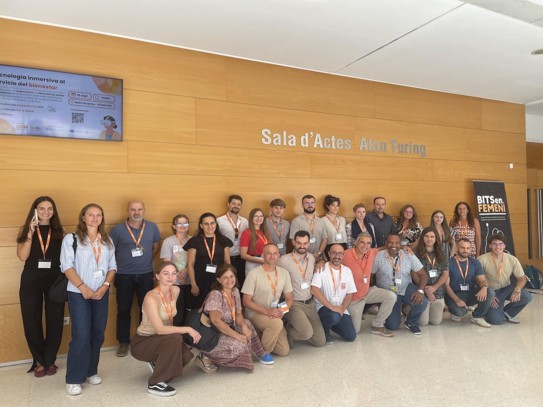
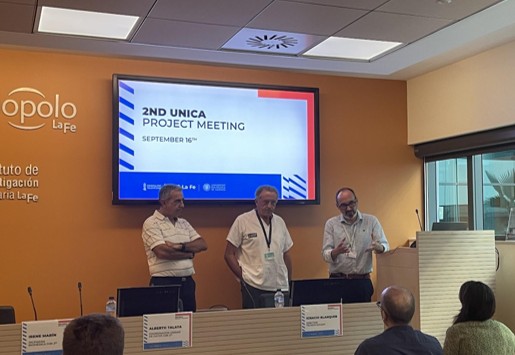
The UNICA consortium met in Valencia to promote European cooperation in cancer imaging and artificial intelligence
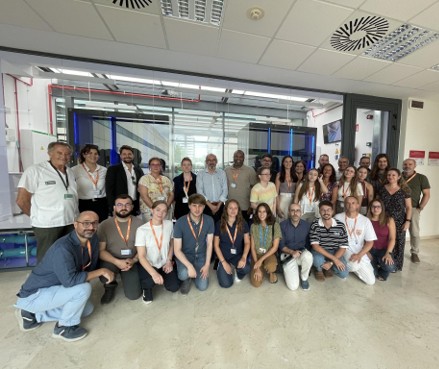
The UNICA consortium met in Valencia to promote European cooperation in cancer imaging and artificial intelligence
Approximately 30 representatives of the UNICA consortium met in Valencia to review the project’s progress and determine the next steps. Representing the University of Ioannina at the meeting was Andreas Miltiadous, Assistant Professor in the Department of Informatics and Telecommunications.
• UNICA brings together 16 partners from across Europe, from Ukraine to the Azores, helping to expand the geographic coverage of the European cancer imaging infrastructure EUCAIM.
• The consortium is proceeding with the integration of clinical data providers into EUCAIM and is preparing the next phases of pilot applications of artificial intelligence for breast and lung cancer.
Valencia, September 24, 2026. Approximately 30 representatives of the European UNICA (Unified Network for International Cancer Advancement) project gathered in Valencia for the consortium’s second meeting. During the two-day meeting, the partners reviewed the progress made during the project’s first year and agreed on the priorities for the next phase.
The meeting was hosted by the Polytechnic University of Valencia (Universitat Politècnica de València, UPV) and the Valencia Research Institute on Artificial Intelligence (VRAIN), while the second day took place at the La Fe Health Research Institute (IIS La Fe).
UNICA (Grant Agreement 101218966) brings together 16 partners from across Europe, from Ukraine to the Azores. The project aims to contribute clinical data and medical images to the European cancer imaging infrastructure EUCAIM, while expanding its geographic coverage and supporting the safe and responsible use of health data for cancer research and the development of artificial intelligence applications.
UNICA leverages federated data management technologies that enable the training and validation of artificial intelligence models without requiring the transfer of sensitive patient information. The project will use explainable artificial intelligence and federated machine learning to develop solutions for cancer imaging, protecting patient privacy and keeping control of the data with the institutions that hold it.
The main topic of the meeting was the ongoing integration of UNICA’s data repositories into EUCAIM, the European Federation of Cancer Imaging.
During the project’s first year, the consortium worked to establish the legal framework required for this process. With the framework now in place, the project is moving toward the signing phase with the participating data organizations.
At the same time, UNICA is beginning to evaluate the available data from its clinical partners. This evaluation will support the design of the process for adapting the data to the FAIR principles, so that cancer imaging data can be more easily located, accessed, interoperable, and reusable, while respecting the necessary legal, ethical, and technical security requirements.
This work represents an important step toward connecting participating clinical institutions with EUCAIM and contributing their data to a broader European cancer imaging ecosystem.
Legal and Ethical Challenges Across Europe One of the key challenges discussed at the meeting was the complexity of collaboration across different national legal and institutional frameworks.
UNICA brings together partners and clinical data organizations from various European countries. Although all operate within a common European regulatory framework, national requirements and institutional procedures may differ.
The consortium therefore worked to find common ground among the different legal frameworks, while ensuring that the protection of patients’ and data subjects’ rights is fully consistent with EU requirements.
The meeting highlighted the importance of the early involvement of legal departments, Data Protection Officers, ethics committees, and security experts. Legal, ethical, and technical security requirements must be taken into account in parallel with the development of the project’s technological solutions, rather than only at a later stage.
Another important issue was anonymization. The consortium discussed a multi-layered approach that includes the removal of direct identifiers, the verification of metadata that could reveal a person’s identity, assessing the risk of re-identification, and processing sensitive data in secure environments.
Ethics committees must also consider how anonymized data can be reused in the future, including through infrastructures such as EUCAIM and, more broadly, within the framework of the European Health Data Space.
Óscar Pastor, UNICA’s scientific director at the UPV’s VRAIN, explained:
“Participation in the European Health Data Spaces requires building trust through verifiable safeguards. It is not enough for institutions to simply have datasets and technology. They must be able to demonstrate that they have the appropriate legal framework, ethical approval, anonymization and security measures, access governance rules, intellectual property management, and clear institutional procedures.”
The second day of the meeting took place at IIS La Fe, which leads the scientific direction of the Central Node of the Cancer Image Atlas within the EUCAIM framework.
The sessions focused on how UNICA will integrate with the broader EUCAIM infrastructure, including its data model and ontology, architecture, interoperability, and the federated approach to data processing.
Ignacio Blanquer, EUCAIM’s technical director, explained how federated processing enables the processing of clinical and imaging data while maintaining security, access control, and providers’ sovereignty over their data.
Different access levels can be applied depending on the sensitivity of each dataset. Some data may be publicly available, while other data can be viewed or processed only within controlled environments. The most sensitive data may remain with the entity that holds it and be processed through the federal infrastructure.
From Interconnection to Artificial Intelligence Pilot Applications
With the legal framework in place and the interconnection process underway, UNICA is now preparing for the next phase of the project.
The consortium will continue to collaborate with clinical data organizations to complete their integration into EUCAIM and develop the process for adapting available cancer imaging data to the FAIR principles.
This will pave the way for the project’s artificial intelligence pilot applications, including breast cancer risk assessment and lung cancer detection from CT scans.
By connecting clinical institutions from different regions of Europe to EUCAIM, UNICA aims to increase the availability and geographic diversity of cancer imaging data and to support the development and validation of reliable artificial intelligence tools for cancer research and care.
The meeting in Valencia marked an important step in this process, bringing together the project’s clinical, technological, legal, and research partners to coordinate their efforts and prepare for the next phase of UNICA.